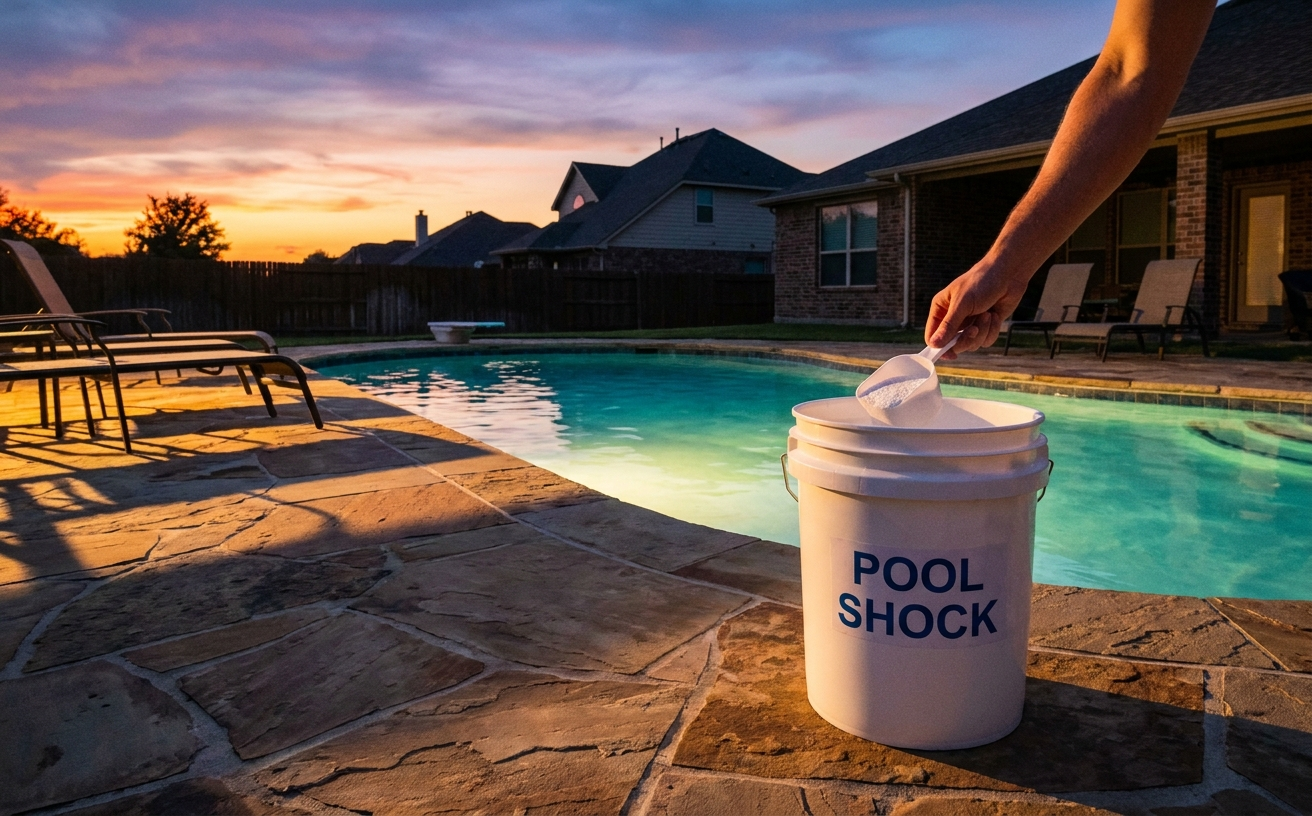
You followed the instructions on the bag. You measured the dose. You poured it in with the pump running. And the next morning, the water looked worse than before. Cloudier. Maybe even a little green around the edges. How is that possible?
It happens more often than you might think. Shocking a pool is not as simple as dumping in a chemical and walking away. There are a handful of common mistakes that can turn a well-intentioned treatment into a setback.
The good news is that once you understand what went wrong, the fix is usually straightforward. And the next time you shock, you will get the clear water you were expecting.
Mistake One: Shocking at the Wrong Time of Day
This is the most common error by far. Pool owners often shock in the morning or midday because that is when they notice the water needs attention. But sunlight destroys free chlorine at an astonishing rate.
When you shock during the day, UV radiation can eliminate a large portion of the chlorine before it has a chance to work. You end up with a fraction of the dose actually doing anything, and the problem you were trying to solve persists.
Always shock in the evening. The chlorine gets the entire night to work through contaminants without competition from sunlight. By morning, the heavy lifting is done.
Why Evening Shock Works Better
- Chlorine has eight to ten hours of darkness to oxidize contaminants
- No UV loss means the full dose reaches the water
- Free chlorine residual is typically established by dawn
- The pool is usually safe to swim in by late morning
Mistake Two: Skipping the Pre-Shock Prep
Shocking a dirty pool is like mopping a floor without sweeping first. The chlorine will spend its energy fighting debris and organic matter instead of sanitizing the water.
Before you shock, skim the surface, brush the walls, and vacuum the floor. Clean out the skimmer baskets and check the filter. Removing physical debris first allows the chlorine to focus on what it does best: killing bacteria and breaking down microscopic contaminants.
Also test your water before shocking. If your pH is above 8.0 or your alkalinity is far out of range, adjust those first. High pH renders chlorine much less effective, which means your shock dose may not deliver the result you expect.
Mistake Three: Using the Wrong Type of Shock
Not all shock products are created equal, and using the wrong one for your situation can create new problems while failing to solve the original one.
Calcium hypochlorite is the most powerful option and works well for routine shocking in areas with soft water. But in regions with hard water, it adds calcium that can contribute to scaling. Sodium di-chlor dissolves quickly and adds stabilizer, which is great for pools that need it but problematic for pools where CYA is already high.
For a complete comparison of products and when to use each one, a reliable pool shock guide explains the differences and helps you choose the right product for your water chemistry and climate.
Liquid chlorine, or sodium hypochlorite, is fast and leaves no residue. It is a strong choice for regular maintenance shocking, but it requires careful handling and has a shorter shelf life than granular products.
Mistake Four: Not Running the Pump Long Enough
Chlorine only works on the water it can reach. If you shock the pool and turn off the pump after an hour, the chlorine sits concentrated near where you poured it instead of circulating through the entire pool.
Run the pump for at least eight hours after shocking, ideally overnight. This ensures the chlorine reaches every corner, every dead spot, and every surface where contaminants might be hiding.
- Add shock at dusk with the pump already running
- Let the pump run continuously through the night
- Test free chlorine in the morning before swimming
- Keep the pump running during the day to maintain circulation
Mistake Five: Shocking Without Testing First
Adding a standard dose of shock without knowing your current chlorine level is guessing. If your chlorine is already high, adding more creates the over-shock problems we discussed. If your chlorine is at zero because of massive demand, a standard dose may not be enough.
Test before you treat. A simple test strip takes thirty seconds and gives you the information you need to dose correctly. It is the single most important step in the entire process.
Also, test your stabilizer level. If CYA is above fifty ppm, your shock dose needs to be significantly higher to achieve the same free chlorine residual. Without accounting for stabilizer, you may underdose without realizing it.
Getting It Right the First Time
A proper shock treatment follows a clear sequence: test, clean, adjust pH, add the right product at the right dose, shock at dusk, and run the pump all night. Skip any step and the results suffer.
When every step is done correctly, the difference is immediate. By the next morning, the water should look noticeably clearer. Free chlorine should be in the target range. Combined chlorine should be near zero.
If the water is still cloudy or the chlorine reading has dropped to zero, the demand was higher than expected. Shock again the following evening using a slightly higher dose. A second treatment almost always gets the job done.
Shocking is not a brute-force exercise. It is a precision tool that works best when you respect the chemistry. Do it right, and your pool rewards you with water that looks and feels the way it should.